Guide · Fast charging
Electric car fast charging costs: what a kWh and a charge cost in Switzerland
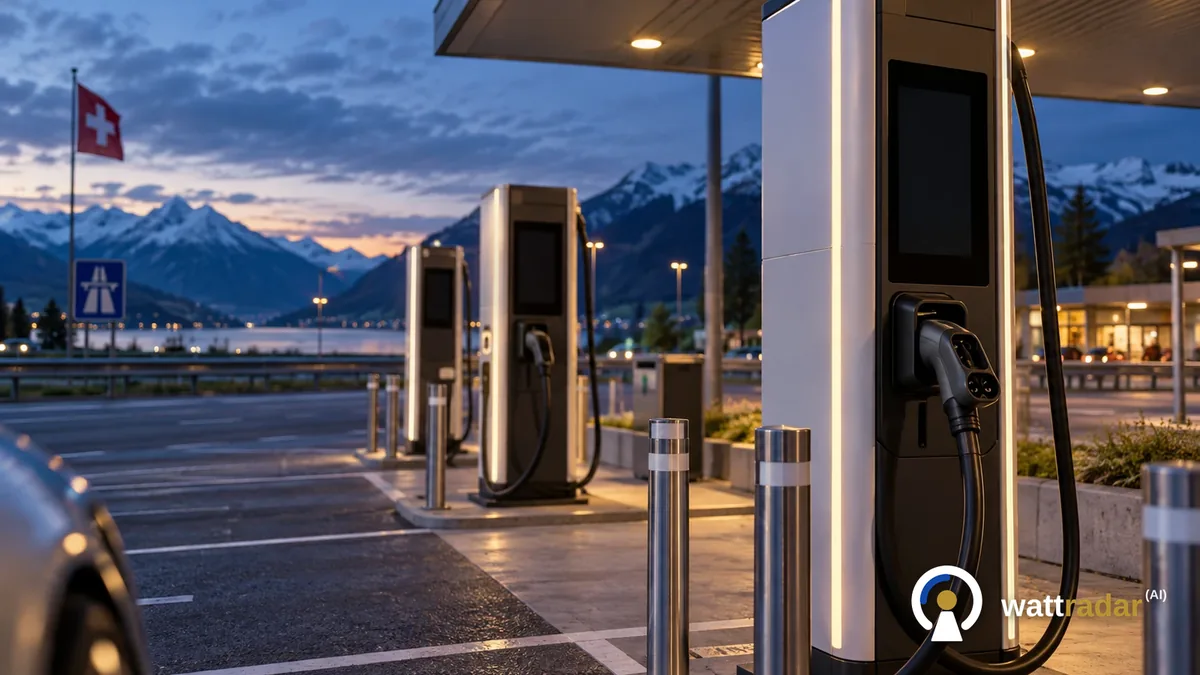
At a fast charger a kWh costs between 65,0 and 119,0 centimes, depending on the network. For a charge of 40 kWh, which at 18 kWh per 100 km is good for 222 km, that is CHF 26.00 in the cheapest and CHF 47.60 in the most expensive network. At home the same amount costs CHF 10.32. This article puts the eight networks side by side and shows what comes on top of the price per kWh.
The eight networks compared
The table uses the roaming prices of a single card, the Swisscharge card, including VAT. The charge of 40 kWh is an assumption; yours may be larger or smaller. The row «at home» uses the federal household tariff for tariff year 2026 (profile H5, «house with an electric car»), excluding VAT.
| Network | Direct current, centimes/kWh | Alternating current, centimes/kWh | 40 kWh on direct current |
|---|---|---|---|
| GOFAST | 65,0 | — | CHF 26.00 |
| MOVE | 69,0 | 57,0 | CHF 27.60 |
| Avia Volt Suisse | 71,0 (from 150 kW: 88,0) | 50,0 | CHF 28.40 |
| Agrola | 75,0 | 49,0 | CHF 30.00 |
| Migrol | 76,0 | 48,0 | CHF 30.40 |
| IONITY | 85,0 | 37,0 | CHF 34.00 |
| Shell | 102,0 | 86,0 | CHF 40.80 |
| eCarUp | 119,0 | 81,0 | CHF 47.60 |
| at home, household tariff (excl. VAT) | — | 25,79 | CHF 10.32 |
Between the cheapest and the most expensive network lie CHF 21.60 per charge. IONITY is the cheapest network in the table on alternating current (37,0 centimes) and the sixth cheapest on direct current (85,0 centimes).
The price depends on power and card
Two price models depart from a single price. Avia Volt Suisse asks 71,0 centimes up to 150 kW and 88,0 above. The Migrol card M-Charge staggers by charging power: 38,0 centimes up to 22 kW, 48,0 up to 64 kW, 55,0 up to 200 kW and 59,0 up to 400 kW. Via the Swisscharge card Migrol asks 76,0 centimes on direct current. Two cards of the same operator thus give two prices; which one applies at which plug, neither source says.
The card can matter more than the network. AMAG states 28,0 centimes in its network for vehicles of the brands VW, Audi, SEAT, Škoda and CUPRA; with another card it is 56,0 centimes plus a start fee of CHF 0.98. The AMAG releases of 2025 and 2026 name the brand once and the place of purchase once as the condition; we follow the later one. Lidl asks 42,0 centimes at its fast chargers with the Lidl app and 62,0 with another card.
What comes on top of the price per kWh
Part of the cost lies outside the price per kWh.
- Idle fee. MOVE adds CHF 0.25 per minute from minute 61, GOFAST CHF 0.28, Agrola CHF 0.18 from minute 91. Anyone who stays plugged in after charging pays it.
- Start fee. The AMAG card charges other cards CHF 0.98 per charging session, which matters on small charges.
According to a press release of 1 October 2026, Energie 360° has bundled Gofast, Swisscharge and Move Mobility under the JOYA brand. MOVE and GOFAST stay separate in the table because the card lists their prices separately.
What we do not know
- The price at your plug. GOFAST and Swisscharge both write that the price depends on the individual station. The table gives network prices, not station prices.
- Direct tariffs. With an operator’s own app or card the same plug can be cheaper than with the roaming card. That is documented only for the networks the Z Volt card covers.
- Today’s price level. The card shows a price level of January 2026. On 10.10.2026 the page still shows that level and points to the app for current prices.
What this means for your charge
- Compare by your car’s charging power. If it charges at less than 150 kW, the lower price applies at Avia Volt Suisse.
- Count the idle time. At MOVE and GOFAST it starts after 60 minutes, at Agrola after 90.
- Check the operator’s app before you drive. It shows the price of the plug you are heading for.
- Check whether a card is cheaper for your car. AMAG and Lidl name two prices depending on brand or app.
What a year of public charging costs compared with home is worked out in the article EV without a wallbox. Locations and prices of individual plugs are in the Charging tab, the fit into total costs in the Total cost tab. How many charging stations each canton has is shown in the article Charging stations in Switzerland.
Sources: Swisscharge, «Charging Prices at Swisscharge» (price level of the card: January 2026, retrieved on 11.09.2026); tariffs of AMAG, Lidl and Migrol with address and retrieval date in ladeanbieter.json ↗; Energie 360°, press release on JOYA; federal household tariff (ElCom), profile H5, tariff year 2026.
Transparency: The cost of a charge is quantity times price per kWh, without idle and start fees. The example assumes 40 kWh and 18 kWh per 100 km, the consumption the «Total cost» tab also uses. Every number in this article is recalculated automatically on every change and searched for in the text, in all four languages.
