Volkswagen ID.3 Pro S
Vehicle report · model years 2024–2026 · sources as of 2026-08-27
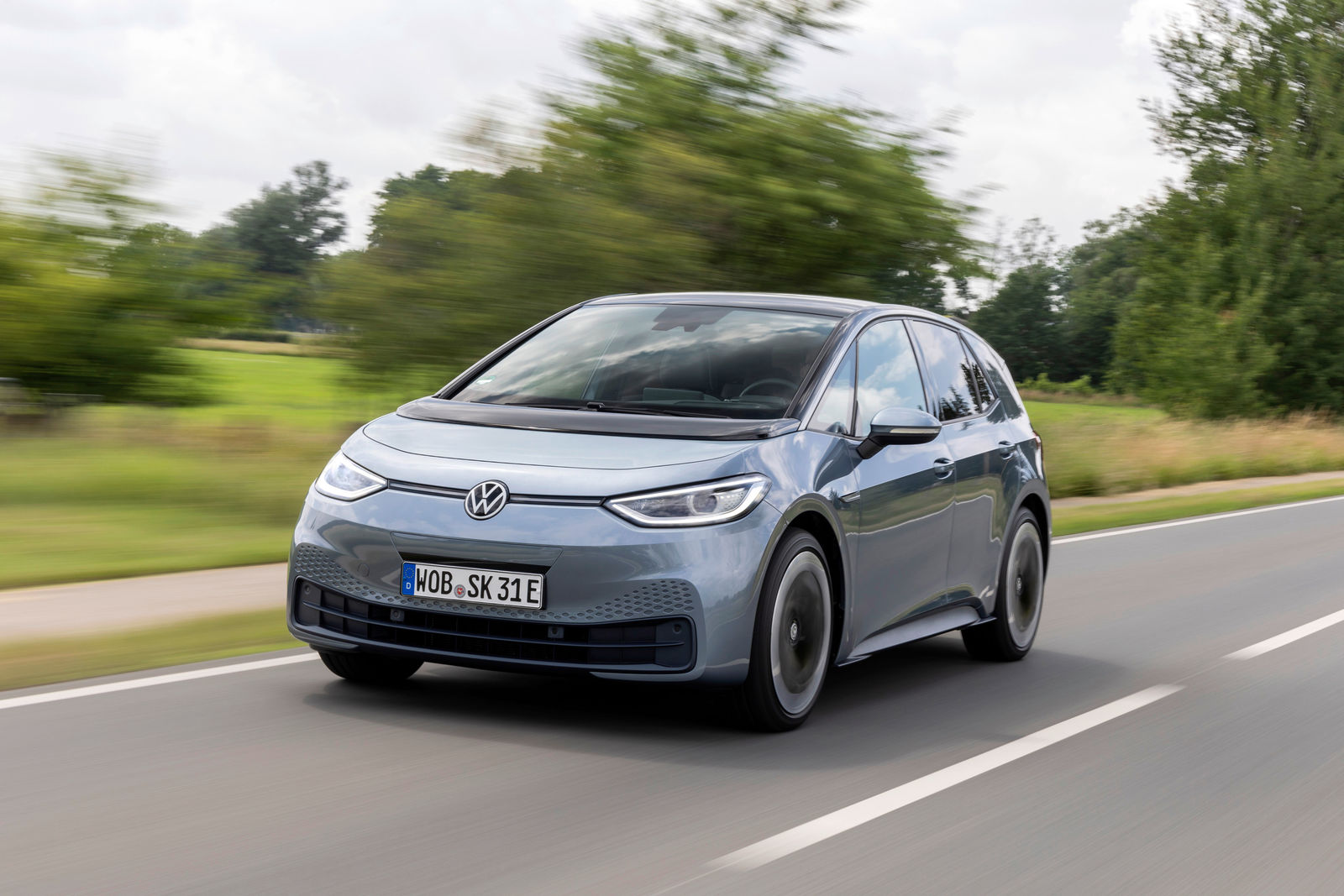
A 77 kWh battery in a car 4,265 metres long. The question is not whether that is enough, but what for.
The essentials in three sentences
- The Volkswagen ID.3 Pro S has 77 kWh net and travels up to 562 kilometres under WLTP; in independent testing it was 450 kilometres at 19,2 kWh/100 km.
- The 20 per cent gap between standard and test is not an error but the difference between rolling road and road — the test figure is the one to plan with.
- Every figure on this page comes from 4 named sources and is attributed line by line. wattradar has not driven this car.
How it drives
Rear-wheel drive and a 10,1 metre turning circle are what set it apart from a Golf, not the length.
The motor sits on the rear axle, the battery in the floor. The resulting weight distribution makes the car settle into a corner more calmly than a front-wheel-drive car of the same size. The turning circle of 10,1 metres is the figure that matters most often in daily use: car park ramps, residential streets, turning in narrow driveways. The top speed of 160 km/h is below what the class normally offers — irrelevant on Swiss motorways, a limitation on German ones. [2]
How far it goes
562 km by the standard, 450 km in independent testing — the gap is the real information.
The WLTP figure is produced on a rolling road under fixed conditions. The Ecotest drives the same car under more realistic ones and counts charging losses: 450 kilometres at 19,2 kWh/100 km. That is roughly 19 per cent below the standard, and that gap is the figure worth planning with. Winter and motorway speeds push it down further — the long-term section below gives numbers for that. Whether range turns into travelling speed depends on the DC charging power of up to 175 kW and on preconditioning when route guidance is active. [1][2]
What fits inside
4,265 metres outside, 385 to 1’267 litres inside — the ratio is the point.
The electric platform pushes the axles apart and does away with the engine bay. For passengers that means a long cabin within a compact exterior length; for luggage it means 385 litres, or 1’267 with the rear seats folded. Roof load and towing are not provided for, according to the long-term test. Anyone who needs a roof box or a trailer is in the wrong place — that is not a judgement, it is an exclusion criterion. [2]
How it is operated
The 12,9-inch screen replaces switches, not habits.
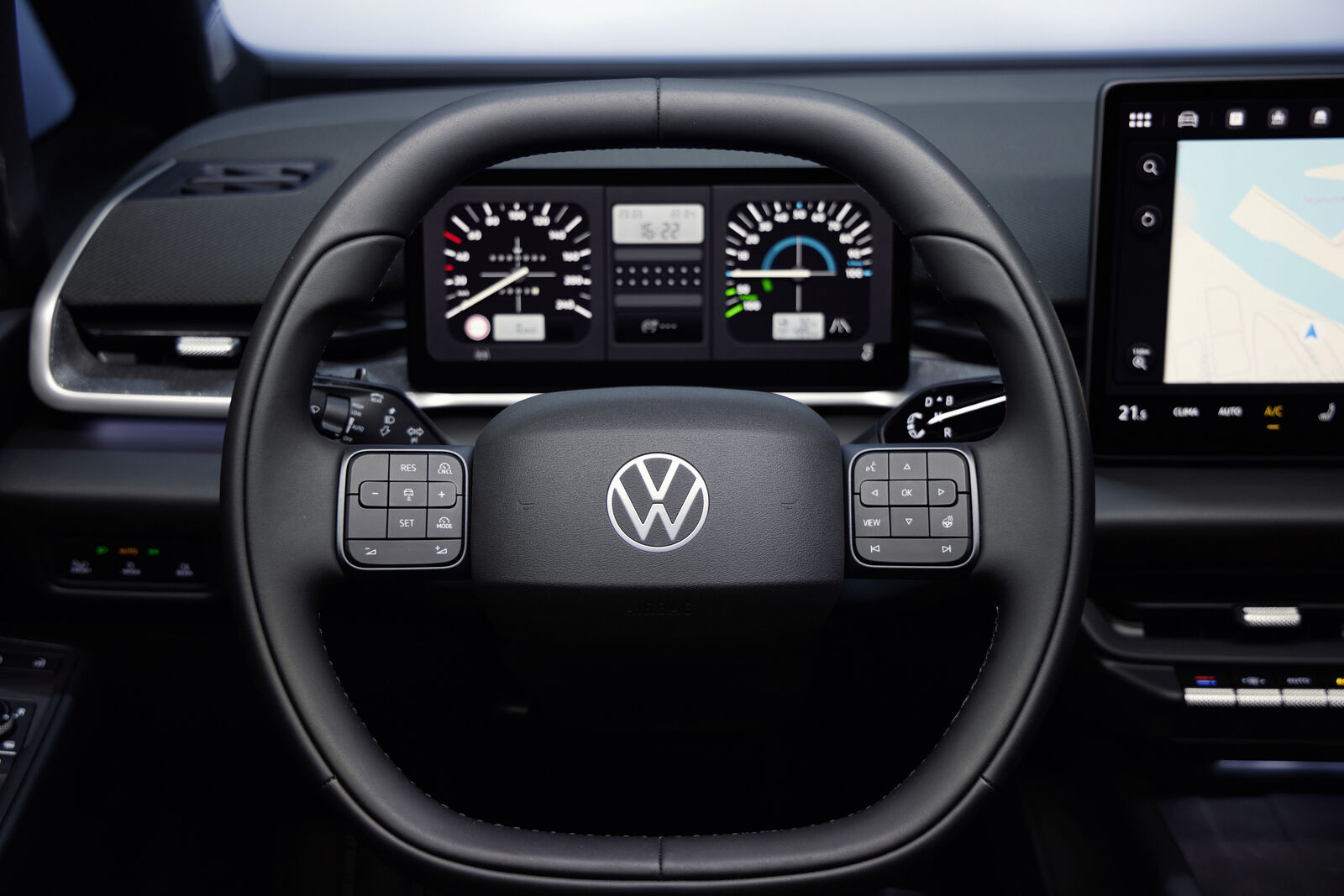
The facelift brought a larger screen, a reworked interface and illuminated sliders. Anyone changing climate control, driving mode or secondary functions still works mostly through the display. Whether that is a problem cannot be derived from data and cannot be decided on someone else’s behalf. It is the point at which a test drive says more than any written report — the long-term test lists the controls among its criticisms. [1][2]
Technical data with a source on every line
Every line says where the figure came from. That is what separates it from a spec sheet.
| Item | Value | Source |
|---|---|---|
| Drive | Rear-wheel drive | [2] |
| System power | 170 kW / 231 PS | [1][2][4] |
| Torque | 310 Nm | [2] |
| 0–100 km/h | 7,1 s | [1][2] |
| Top speed | 160 km/h | [2][4] |
| Battery, net | 77 kWh | [1][2] |
| Battery, gross | 82 kWh | [1][2] |
| AC charging | 11 kW | [2] |
| DC charging | 175 kW | [1][2] |
| DC charging time | 29 min (10–80 %) | [2] |
| WLTP range | 562 km | [4] |
| WLTP range, differing source | 567 km | [2] |
| WLTP range per manufacturer | 559 km | [1] |
| Range in independent testing | 450 km | [2] |
| Consumption in testing, charging losses included | 19,2 kWh/100 km | [2] |
| Braking distance 100–0 km/h | 36,6 m | [2] |
| Length | 4’265 mm | [4] |
| Width without mirrors | 1’809 mm | [2][4] |
| Height | 1’552 mm | [4] |
| Turning circle | 10,1 m | [2] |
| Boot | 385–1’267 l | [2] |
| Kerb weight | 1’957 kg | [2][4] |
| Wheelbase | 2’770 mm | [4] |
| Gross weight | 2’420 kg | [4] |
| WLTP consumption | 15,8 kWh/100 km | [4] |
| Drive-by noise per type approval | 64 dB(A) | [4] |
How common is it?
In the current reporting period 889 vehicles of this model were newly registered in Switzerland — rank 10 of 346. This page says what the car can do; the model page says how often it is bought. Those are two different questions, and they are deliberately answered separately.
What it is good for
- A large battery in a compact format: 77 kWh net in a car 4’265 mm long.
- A turning circle of 10,1 metres — the figure that matters most often in Swiss daily use.
- Rear-wheel drive and a low battery give calm, unstrained road behaviour.
- The long-term test documents 89 per cent battery state after 220’158 kilometres.
What to check before buying
- Roof load and towing are not provided for according to the long-term test — for a roof box or a trailer this is the wrong car.
- Try the touch controls deliberately on a test drive; they cannot be judged from data.
- Winter and motorway speeds push range well below the 450 kilometres of the independent test.
- The WLTP figure differs by source: 562 kilometres in the Swiss type approval, 559 from the manufacturer, 567 in the ADAC data sheet. We carry the type-approval figure, because Swiss registration rests on it.
What is left after 220’158 kilometres
The only figure on this page that comes from use rather than from a measurement run.
An independent long-term test followed a car of this series over 220’158 kilometres across 5 years. A measurement using the Aviloo Premium method then returned a battery state of 89 per cent, with a stated tolerance of 3 percentage points. On the motorway the test reports around 400 kilometres when driven gently, and 300 to 320 at sub-zero temperatures. Calculated across the whole test period, consumption came to 23 kWh/100 km including charging losses; on-board computer figures without those losses ranged between 13 and 30 depending on use and weather. [3]
This is the result of a single car. It is not a statement about the series and it is not a warranty.
The test car is an earlier model year than the one described here. Charging power, software and equipment therefore do not carry over; the battery measurement does so only within limits.
What these figures do not say
The standard figure and the independent test figure come from different procedures and cannot be converted into one another. That is why both appear, and why neither is called «the» range.
For WLTP range the sources give 3 different figures: 562 km (Bundesamt für Strassen ASTRA), 567 km (ADAC), 559 km (Volkswagen Newsroom). Which one applies cannot be decided from here, so all of them stand. For registration in Switzerland the type-approval figure governs, that is 562 kilometres; it too describes the standard cycle, not the road.
The manufacturer figures come from a press pack that applies to the German market. Equipment, designations and availability may differ in Switzerland; the configuration of the actual car should be checked before signing.
No Swiss price is given for this car on this page, because none could be established reliably from the sources examined. Where a price is available it appears with the date it was retrieved — a price without a date goes stale silently, and that is the kind of error nobody notices.
wattradar does not award scores. A rating without a published method is an opinion dressed up as a number. What appears here are the figures, their sources and one sentence each on what they mean.
The figures for reuse
The same data set as a file, with a source key for every value. CSV with semicolons, so that Excel in a German-language environment separates the columns.
Sources
- Volkswagen Newsroom, «Major upgrade for the ID.3» — https://www.volkswagen-newsroom.com/en/press-releases/major-upgrade-for-the-id3-pre-sales-launch-with-pro-s-model-18359. 2024-02-05 · manufacturer figure
- ADAC, «Test VW ID.3: So viel besser ist er seit dem Facelift» — https://www.adac.de/rund-ums-fahrzeug/autokatalog/marken-modelle/vw/vw-id-3/. 2025-08-12 · independent measurement
- ADAC, «Dauertest: 220.000 km im VW ID.3 – hält der Akku?» — https://www.adac.de/rund-ums-fahrzeug/autokatalog/autotest/vw-id3-dauertest/. 2026-07-10 · independent measurement
- Bundesamt für Strassen ASTRA, «eDatenblatt — Typengenehmigungsdaten, offene Behördendaten» — https://opendata.astra.admin.ch/ivzod/3000-eDatenblatt/. retrieved on 2026-08-28 · independent measurement
How this report was put together
This report draws together publicly available manufacturer and test sources. wattradar has neither driven nor measured this car. It replaces neither a test drive nor a check of the specific configuration.
Picture credits
The vehicle photographs are manufacturer press images and are used with attribution. They show cars in trim levels that may differ from those available in Switzerland. aufmacher.jpg: Volkswagen Newsroom (https://www.volkswagen-newsroom.com/) — Pressebild des Herstellers, redaktionelle Nutzung mit Quellenangabe. cockpit.jpg: Volkswagen Newsroom (https://www.volkswagen-newsroom.com/) — Pressebild des Herstellers, redaktionelle Nutzung mit Quellenangabe.
